|
Christian
Media
Communiqué
Escape From Planet Egypt
Part XIII
With the enormously important discovery of the Tell El Amarna letters in Egypt, and the knowledge these documents impart concerning the generation leading up to (and following) the reign of Amenhotep IV (Akhnaton), the information contained bridges the gap to the discovery of the Chronicles of Assyria.
In 1849, tablets from what is called the Library of Assurbanipal of Assyria were discovered in the locale of ancient Nineveh. Cuneiform writings uncovered in the ancient capital of the Assyrian Empire resemble the letters of Tell El Amarna in Egypt, and the knowledge of antiquity increased once again.
Unfortunately, as we've repeatedly shown, ancient artifacts and records are consistently misdated by synchronizing them with the earliest accounts previously associated with Egypt. The Egyptian records found at Tell El Amarna, the reader will recall, reveal the particulars of ancient Akhet Aton, the capital from which Pharaoh Akhenaton ruled.
The Amarna period features material related to the reign of Amenhotep IV – who was the notorious Pharaoh that changed his name to Akhnaton, as he sought to propagate a new religion of a god he called "the Aton."
It was during his time that the end of the dynastic Egyptian rule loomed, even as the rise of the Assyrians began to approach Egyptian assets. Egypt was already in decline in the time of Akhenaton, but the momentum of the kingdom which had dominated the ancient Near East was still formidable.
More importantly, the Amarna letters actually document events in the 8th century BC, in the time of Old Testament Israel, Judaea, Moab, and Syria. As Egypt still dominated Ben Hadad in Damascus Syria, as well as the two houses of Israel (Judaea in the South and Samaria in the North), and the adjacent kingdoms of Edom and Moab, the Amarna letters reveal that playing the various vassal states against each other kept them from uniting against the throne in Akhet Aton.
For example, in our last chapter we noted that Syria and Moab had been paying tribute to Samaria, who in turn, was subordinate to Egypt. When King Asa of Judaea defeated the forces of Zerah the Ethiopian (as seen in II Chronicles 14:9 when Asa had turned back to the LORD), Judah was growing stronger and, since the Judaeans still greatly resented Jeroboam's rebellion against the hereditary house of David, friction continued against Asa's rival in the North.
After Jeroboam died and his son Nadab briefly reigned for two years, a new dynasty led by Baasha came to power in Samaria (we note the double A in Baasha's name, which points us to the name Baal).
Before Baasha, Jeroboam had set up alternative sites with golden calves for worship, in order to keep the Northern Israelites from going up to the Jerusalem temple. He feared the historic belief of the Israelites would resurface, resulting in them turning their hearts back to Judaea.
"And he made an house of high places, and made priests of the lowest of the people, which were not of the sons of Levi" (I Kings 12:31).
Baasha reignited open hostilities against Judaea, and militarily built up Ramah, which was strategically selected to intimidate any Israelites from going back to the temple in Jerusalem in Judaea, because it was ruled by David's descendant, good king Asa.
"And Baasha king of Israel went up against Judah, and built Ramah, that he might not suffer any to go out or come in to Asa king of Judah" (I Kings 15:17).
Thus, just like Jeroboam before him, Baasha thought to perpetuate an alternative to following the LORD in order to sustain his own political position. The identical pattern was seen many centuries later – in the time of Christ – when the religious establishment was willing to murder their own Saviour in order to protect their own political position.
"Then gathered the chief priests and the Pharisees a council, and said, What do we? For this man doeth many miracles. If we let him thus alone, all men will believe on him: and the Romans shall come and take away both our place and nation" (John 11:47,48).
Back in the 8th century two house world of Samaria and Judaea, the Scriptures tell us that Asa's response to Baasha's building of Ramah (to block traffic to Jerusalem) was to politically construct a treaty of friendship with the king of Damascus, Ben Hadad, in an effort to disrupt the tributary relationship between Syria and Baasha of Israel.
"Then Asa took all the silver and the gold that were left in the treasures of the house of the LORD, and the king's house…and sent them to Ben-Hadad" (I Kings 15:18).
The Amarna letters tell us that, unlike Egypt's other vassal cities and states, Jerusalem had greater autonomy, as there was no permanent deputy reporting to the Pharaoh. It is noteworthy that Judaea also had vassals (such as Arabia, and the Philistines), who paid them tribute.
Recognizing that Jerusalem had a preferential arrangement with the Pharaoh, and using his newfound relationship with Judaea as a cover, the Bible then tells us that Ben-Hadad of Syria broke relations with Northern Israel, and ended up sending troops against Baasha.
"And it came to pass, when Baasha heard [of Ben-Hadad's rebellion against Northern Israel], that he left off building of Ramah…then King Asa…took away the stones of Ramah, and the timber thereof…and built with them Geba of Benjamin, and Mizpah" (I Kings 15:21,22).
This tells us the militarization of Ramah, which had intimidated any Israelites from returning to the God of their fathers by going up to worship in Jerusalem, was neutralized.
As the fortunes of the Jews and the house of David in Jerusalem increased, the fate of the Northern Israelites sharply declined. Baasha was overthrown by Elah, who was murdered by Zimri, who only reigned for seven days. Then Omri, who was a military captain, seized power. His evil rule began the 4th dynasty of Israel, as he and his son Ahab would reign for many years.
It was Omri who purchased a hill from a man named Shemer, and built the city named after him, which was called Samaria. Eventually, the name of Samaria would also be applied to the entire Northern kingdom.
When Omri "slept with his fathers" (I Kings 16:28), King Ahab made a public commitment to Baal and Ashteroth, by building a temple for Baal, and a grove dedicated to the female half of the stellar deities.
"And [Ahab] reared up an altar for Baal in the house of Baal, which he had built in Samaria. And Ahab made a grove" (I Kings 16:32,33).
When Ben-Hadad of "Dumuska" (the spelling of Damascus in the Amarna letters) allied himself with Asa of Judaea against the king of "Sumur" (the spelling of Samaria in the Amarna letters), he recruited a coalition of "chieftans" to assist him in his attack on "Sumur."
At this time, the soldiers of King Jehoshaphat in Judaea were arranged in a feudal fashion, as the captains of each contingent were appointed on a hereditary basis.
"These are the numbers of them according to the house of their fathers…these waited on the king, beside those whom the king put in the fenced cities throughout all Judah" (II Chronicles 17:14,19).
There were five of these "captains" with large military contingents in Judaea, and the Amarna letters show they corresponded directly with the Pharaoh in Akhet Aton. Even though they were tasked with protecting the sovereign of the land (Jehoshaphat in Jerusalem), they received direct orders from the Pharaoh.
The Scriptures name these five captains, who commanded hundreds of thousands of troops.
"And the men of war, mighty men of valour, were in Jerusalem…of [the tribe] Judah, Adnah the chief…"
"And next to him was Jehohanan the captain…"
"And next him was Amasiah the son of Zichri…"
"And [of the tribe] of Benjamin, Eliada a mighty man of valour…"
"And next him was Jehozabad…these waited on the king" (II Chronicles 17:13-19).
In addition to the five hereditary military divisions just mentioned, Egypt sustained governors, deputies, and troops to protect them within their vassal states. As three of the five captains named in the Scriptures are specifically named in the documents excavated at Tell El Amarna, we consider it to be conclusive proof that the letters from the Pharaoh's capital at Akhet Aton coincide with the place and time mentioned in the Scriptures.
This is a crucial fact, as consensus scholarship still claims these documents from El Amarna are from the 14th century BC (during the time of the Judges in Israel), whereas the internal evidence indicates they are actually from the 8th century, coinciding with the books of Kings and the Chronicles.
In short, they show that Pharaoh Akhenaton was a contemporary of Ahab of Israel, and Jehoshaphat of Judaea. Thus, once again, we have continued to match sequential Egyptian records with the chronological Biblical narrative – powerful evidence the timelines of secular history have been consistently misdated, in support of a Spiritually malevolent, ulterior motive.
As Jehoshaphat was increasing in power at that time, and he supported Ben-Hadad's invasion of Samaria, the Amarna letters show King Ahab complained to the Pharaoh, and asked him to send his archers to defend Samaria.
In this regard, Ahab sent multiple letters to the Pharaoh requesting military assistance – and in most cases, they were ignored. As we have noted, Akhnaton was interested in religion, and tried to avoid involvement in the political affairs of state. For example, one of the Amarna letters from the king of Israel to an official serving Akhnaton, asks why his request of military assistance has not arrived.
"Why hast thou held back and not said to the king that he should send archers that they may take Sumura? What is Abdi-Ashirta [Ben-Hadad of Damascus] the servant, the dog, that he should take the land of the king to himself?" (Amarna letter #71).
As the Syrian assault against Samaria unfolded, the Amarna letters have King Ahab virtually pleading with the Pharaoh to intervene.
"Let the king, my lord, know that powerful is the hostility of Abdi-Ashirta [Ben-Hadad in the Scriptures], and that he has taken all my cities to himself" (Amarna letter #81, written to Amenhotep IV).
After multiple letters were ignored, Ahab wrote directly to the Pharaoh. In one letter, he referenced a friend of his, who was the Egyptian governor that had been recalled to the Pharaoh's side in Akhet Aton after his posting in Samaria. His friend was named Amon (named after the Egyptian deity), and Ahab requested that Amon return to Samaria with Egyptian archers to defend the Pharaoh's vassal state.
"Verily, Aman-appa [Amon] is with thee. Ask him. He knows that and [he] has seen the distress which oppresses me" (Letter #74 in the Amarna collection).
In the Scriptures, there is an account when Ahab asked a prophet of the LORD if he should engage in a certain battle, and the prophet Micaiah gave him an answer he did not like, so Ahab ordered Micaiah arrested, and taken and placed in the custody of this same Egyptian official.
"Then the king of Israel said, Take ye Micaiah, and carry him back to Amon the governor of the city" (II Chronicles 18:25).
In Ahab's war with Ben-Hadad of Damascus, the aggression of Abdi-Ashirta (the Ben-Hadad in the Scriptures) was an ongoing subject. The identification of the invader of Samaria as the king of "Amuru land" (related to the name Aram – meaning Syria in the Amarna letters), was confirmed in an inscription of the Assyrian king Shalmaneser III (Ancient Records of Assyria, Luckenbill, 1926).
In the context of the Amarna name Amuru (as applied to Syria), I'll remind the reader the Amalekites of the generation immediately following the Exodus were also called the Amu – to say nothing of the fact they were said to have taken the land of Syria as well as Egypt when they seized the throne of the Pharaohs, and came to be known as the Hyksos dynasty.
The Syrian attack on Samaria finally triggered a response from the Pharaoh, as the federal forces of Egypt, which were in service to the "governor," were ordered to repel the enemy from Damascus. These fighting men were referred to as "the young men" who were attached to the "princes of the provinces," with the word princes referring to the governors that were appointed by the Pharaoh.
The Scriptures tell us the LORD sent a prophet to tell Ahab that he would be victorious. They also tell us that Ahab himself, backed up by the forces commanded by the Pharaoh, took the field and defeated the Syrians.
When God's unnamed prophet told Ahab of the forthcoming victory, the king asked who would provide the military muscle to fight the Syrians.
"And he said, Thus saith the LORD, Even by the young men of the princes [read governors] of the provinces" (I Kings 20:14).
When Ahab asked the prophet who will lead these troops, the prophet told the king he was to personally take charge.
"And the king of Israel went out, and smote the horses and chariots, and slew the Syrians with a great slaughter" (I Kings 20:21).
It was shortly after this great victory of Ahab wherein Ahab sought to acquire the vineyard of Naboth due to its proximity to his own palace. Although Queen Jezebel had energetically promoted the worship of Baal in Israel, the people all knew the LORD had ordained Ahab's victory over Syria. Thus, it was at this time the nation was seeking to mingle the worship of the LORD with the veneration of Baal.
This is precisely the Spiritual condition of Israel which existed when the prophet Elijah came on the scene, and asked the people of Israel, how long were they going to continue to serve two masters.
"And Elijah came unto all the people, and said, How long halt ye between two opinions? If the LORD be God, follow him: but if Baal, then follow him" (I Kings 18:21).
– James Lloyd
To Be Continued
___________________________________________________
|

Charlie
Great and Marvelous
Stealth Dispensationalism
Gene Autry-Doja Cat
The Baal Bible
The Revolutionary Role Reversal
Ten Kings
Image Of The Beast
Something
Deadly Wound
You're In The Army Now
The Remnant Of Israel
Kingdom Within You
Jesus IS
New Heart From Heaven
Rivers Of Babylon
One Night Town
Centuries
Whore Of Babylon
Crazy
Get Away
Turn Up The Radio
I Hear You Knocking
Circle Of Friends
|
|
Click here to make CMTV your
homepage
Christian Media Network Catalog
Also from James Lloyd
|
The Baal Bible DVD
James Lloyd summarizes the role of the heathen "scriptures" from Mesopotamia, which the scholars are using to leaven the genuine Word of God. In what he has dubbed the "Baal Bible," these Gentile writings speak of the Creation, the Garden episode, and the Great Flood, even as they glorify Baal. Part of a much larger conspiracy, since these Satanic records provide a distorted version of Genesis, the faulty dating of the scholars has conned Christian leaders into telling us the Baal Bible is the original, and the Hebrew Scriptures are the copy!
Details Here!
Escape From Planet Egypt
This new book is the electrifying story of how the Spirit of Antichrist has deceived the scholars into believing the Occult material from ancient Gentile writings generated the growing belief in the Divine Council heresy. James Lloyd's earlier book, Dead Men's Bones, provided a Scriptural refutation of the doctrine that claims the LORD directs a "council" of lesser gods, fallen angels, and heavenly beings.
Details Here!
Thou Shalt Ascend:
The Storm Of Gog and Magog
Thou Shalt Ascend details the amazing reality of how the devils came to battle JESUS CHRIST at the entrance of the kingdom of God. In the new Christian Media DVD, Thou Shalt Ascend: The Storm Of Gog and Magog, James Lloyd shows how the fabled Gog and Magog Prophecies show a deeper Spiritual layer of the military conflict at the end of the age, as they actually describe the war in heaven (Revelation 12:7), when the dragon (and his Angelic Rebel Coalition) is cast out of heaven.
Details Here!
The 5th Dynasty
Related to the concept of Twin Timelines in which sequential episodes occur more than once in Scripture and History, this DVD looks at the rebellions against Moses in the Wilderness. Recognizing the failed revolt in Numbers 16, in which Korah and his followers died trying to overthrow Moses, the same thing occurred in 1649 AD as a parallel Christian rebellion tried to seize the throne of England for Christ. Known as the 5th Monarchy, James Lloyd connects this historical event with the 5th Dynasty of Israel, led by Jehu in I Kings 19:16.
Details Here!
Serpents, Scorpions, And Seventy Sons
Another new DVD from James Lloyd, Serpents, Scorpions, and Seventy Sons is 2 hours of dynamite video, derived from the TV program The Apocalypse Chronicles. Using the Scriptural record, James shows how the number 70 was related to the LORD's election of Israel, as
His mediator to the Gentiles. The number is based on the presence of the children of Israel in Egypt, and this study shows how it symbolizes God's redemptive process, as Israel was chosen as "a light to the Gentiles"
(Isaiah 49:6).
Details Here!
The Saga Of Esau
Distilling Esau's behavioural patterns down to two themes related to how he despised the will of the LORD, and assigned blame to innocents whom he purposed to kill, James shows how The Saga of Esau is echoed in the Edomites, King Herod, the religious council of the Jewish leadership which rejected Christ, and even Antichrist and the False Prophet.
Details Here!

Twin Timelines DVD
Tying the various events of the presidential campaign (and the first 9 months of the Trump presidency) to what we call the Prophetic Parallels, this amazing new DVD features James detailing the entire cycle of the Twin Timelines – including predictions of where we go from here.
Details Here!

Dead Men's Bones DVD
A 2 hour DVD in which James Lloyd refutes the false doctrine of the Divine Council Paradigm. Spreading like wildfire, prophecy teachers are claiming God turned over the Gentiles (at the Tower of Babel) to a "council" of angels and the false "gods" of the Gentiles. The heresy is based on heathen manuscripts praising Baal and, incredibly, many Christian scholars are claiming certain Old Testament verses were derived from writings dedicated to Baal!
Details Here!

Traversing The Triuniverse
Traversing The Triuniverse is a unique new studio audio narrative from James Lloyd. Based on the article of the same name, James reviews the twin timelines concept, which has been previously examined, wherein the New Testament events parallel the Old Testament sequences. Now, in Traversing The Triuniverse, he takes the prophetic parallels a step further, showing how the Spiritual fulfillment is the substance, but the physical timeline, inhabited by the Spirit of Antichrist, which is the shadow, takes the same sequence, and reverses the roles.
Video Here!
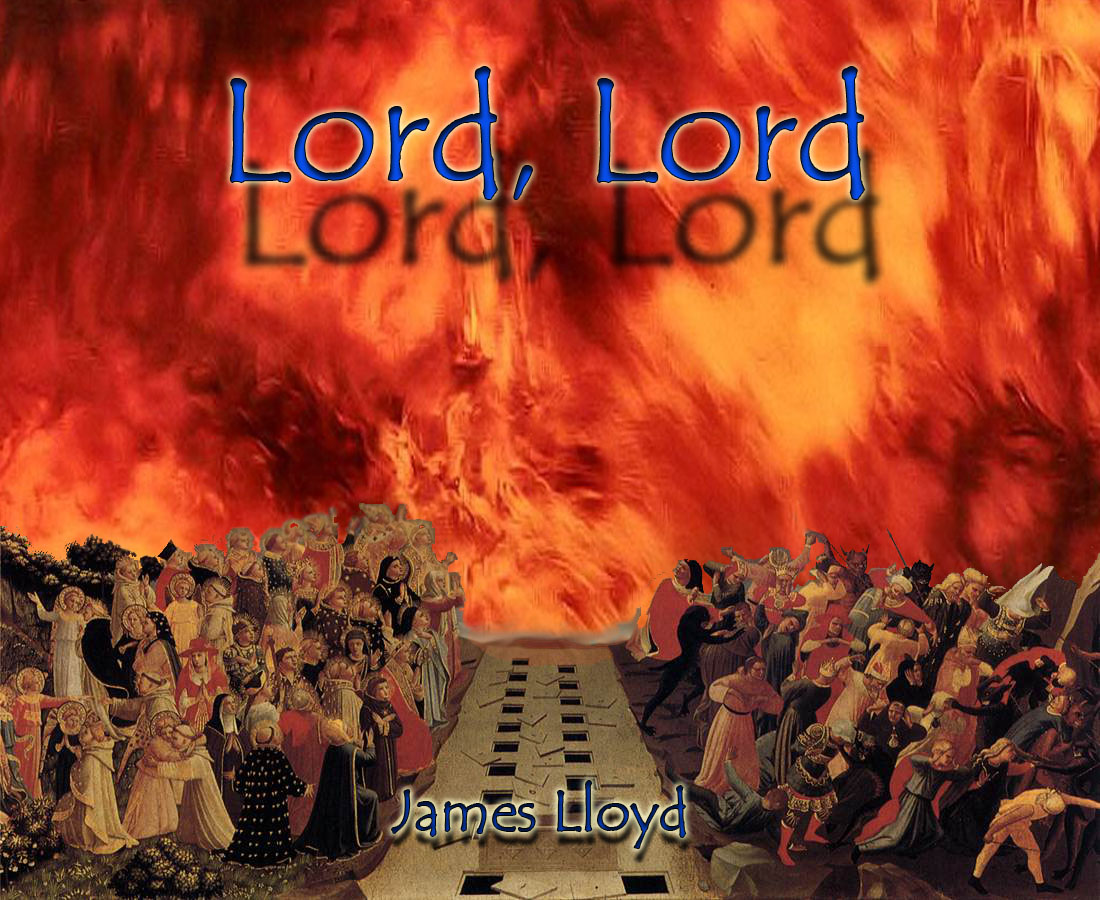
Lord, Lord
Those famous words, familiar to Christians reading the New Testament, are spoken at the time of judgment, when the Bible says MANY will be turned away. Most believers are also aware of the ominous response in which Christ tells this "many" to depart from Him, as He never knew them.
Details Here!

A Light To The Nations - Book
This book includes the astonishing prophetic metaphor where Jonah, symbolizing Old Covenant Israel, resists the call to prophesy to the Gentiles, and sails to Europe to escape the LORD's will. Swallowed up in symbolic Death – and then deposited back onto the land, where the Christ rejecting state re-emerges in 1948 as an involuntary witness, Jonah is an important figure in prophecy. Meanwhile, true Spiritual Israel is seen passing through the sea, walking in the will of the LORD, at the Exodus, even as the earthdwellers (the Egyptian host in the text) are destroyed.
Details Here!

The Rise And Fall Of The Romerican Empire - Book
In this amazing book, James brings together all the components of prophecy, including the Prophetic Parallels, the 6, 7, 8 Cycle, the Beast That Was sequence, the Little Horn, and the Twin Timelines of Bible Prophecy. Integrating these modularized phenomena into a seamless whole, The Rise and Fall Of The Romerican Empire deciphers Bible Prophecy in an unprecedented fashion.
The identity of Antichrist is again revealed in this work, as well as clearly showing where we are now in the prophesied sequence of events. His largest book in 20 years, the Rise and Fall Of The Romerican Empire is the definitive work which systematically presents the truth of Remnant theology.
Details Here!
The Collective - Book
This book details how the Spiritual entity is essentially the opposite of the body of Christ. Symbolically articulated in the book of Revelation as the Image of the Beast, the Spiritual formation could also be described as the body of Antichrist. This polarity places the body of Christ on one end of the Spiritual spectrum, and the body of Antichrist on the other.
Details Here!

The Culting Of Christianity - Book
The Culting Of Christianity links Egyptian mysticism to leaders in the early church, as well as Jewish opponents of Christianity.
An incendiary breakthrough, James conclusively shows the idea of a pre-tribulational evacuation was written in religious documents before Jesus was born. And it doesn't stop there, as James tracks how Occultic writings influenced the development of early Christian doctrine.
Details Here!

The Counterfeit Antichrist
The first new DVD from James Lloyd in several years, this 2 hour TV program examines the rapidly growing idea the appearance of "the" Antichrist will be tied to the prophesied Moslem saviour figure known as The Mahdi.
Many Christian preachers and prophecy authors are now embracing a variation on the ancient "revived Roman Empire" lie with a scenario in which the end times "Antichrist" arrives as a powerful leader from the Islamic world. Leaning on Islamic prophecy itself, in the process of presenting their case in books, television programs, and speaking engagements, these false prophets are pitching another gospel (II Corinthians 11:4) which fails to recognize the truth about the Spiritual entities – commonly identified as Antichrist and The False Prophet -- found in Revelation.
Video Here!
|
The Christian Media Ministry makes our materials available through gifts made to the ministry. When you help Christian Media, we reciprocate with the materials in which you've indicated an interest. Supporters of our ministry do so because they believe in the message the LORD has given us, and we seek to follow the Spiritual directive which Christ gave to the Apostle Peter, in that we seek to feed His sheep. This constitutes a contract, in that gifts we receive indicate a willingness to be instructed in the things of the LORD, as the supporting gifts we receive from the body of Christ allow us to continue in the mission He has called us to.
Help row the CMN boat
Click on the oar
to donate with Paypal
Online CM Fellowship
For Remnant Believers
To join
send an email to
JamesLloyd@mediachristianman.com
Volunteer Programs
- If you'd like to serve the cause of Christ, we have
Internet volunteer programs in place - just email James Lloyd at
the above address
|